Ethan Crossfield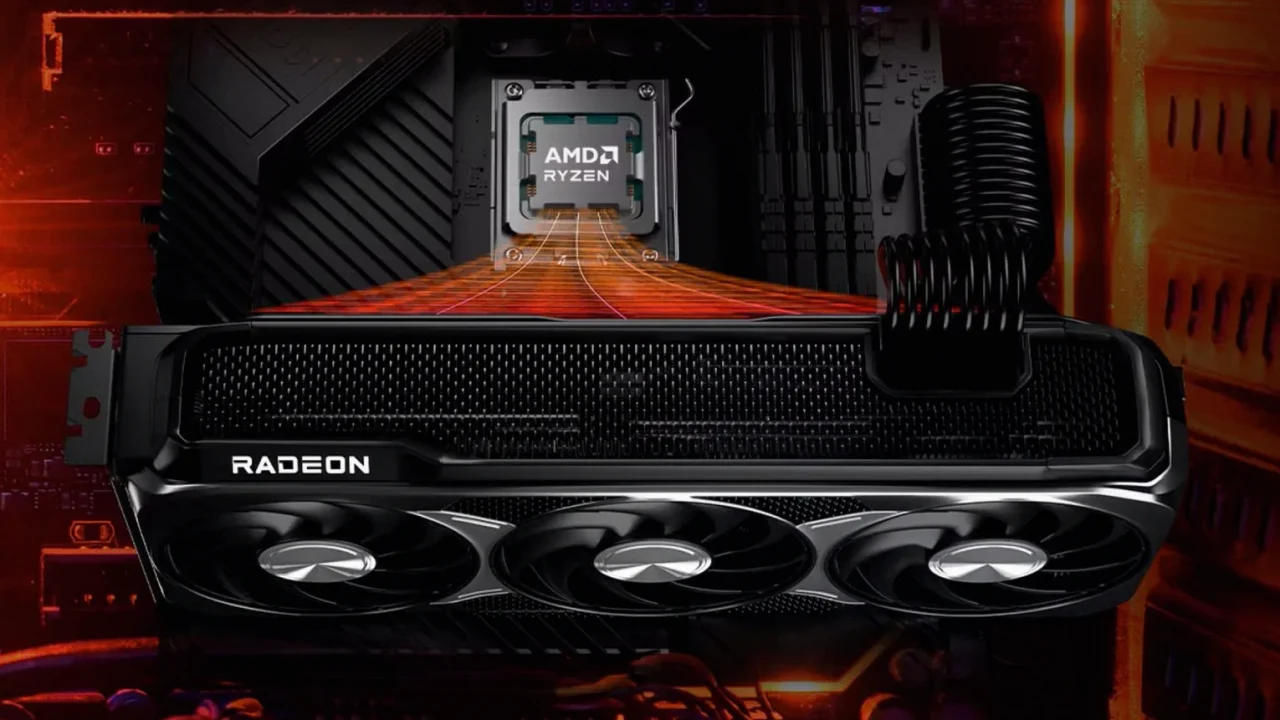
Graphics hardware increasingly has to balance visual complexity against limited video memory, especially as ray tracing and animated environments become more demanding. AMD has presented a research technique that could ease that trade-off: its Tetrahedral Cage Approach is designed to support ray tracing around animated objects while using substantially less memory than a conventional method. The technology is not currently confirmed as a feature in released games, but its demonstration points to a possible path for more detailed scenes on existing and future AMD-based hardware.
AMD’s research targets a difficult ray tracing problem
AMD Fellow Holger Gruen described the Tetrahedral Cage Approach through GPUOpen as a way for developers to ray trace around animated, unique cages. The method was shown in a technical demonstration featuring dense grass and trees, environments that can place significant demands on both geometry processing and video memory.
The approach is intended to provide a more efficient alternative for certain workloads rather than replace every existing animation technique. AMD’s demonstration used a Radeon RX 9070 XT with 16GB of GDDR6 memory and reportedly maintained more than 60 frames per second at 1080p. Those results come from a research demo, so they should not be treated as a guarantee for commercial games or different hardware configurations.
The memory difference could be substantial
AMD compared the tetrahedral cage method with a traditional clustered approach. Clusters can give developers more precise control over vertex animation, but the example required more than 80GB of video memory. The tetrahedral cage version used 1.7GB for the same demonstrated workload.
That gap does not mean every game would see the same reduction. The two approaches serve different purposes, and AMD indicated that tetrahedral cages may be especially useful for ray-traced foliage and characters viewed at a distance. Even so, reducing the memory footprint of complex animated assets could give developers more room to build detailed environments without requiring higher-capacity graphics cards.
Possible implications for PCs and consoles
AMD already supplies Ryzen processors and Radeon graphics cards, while its hardware also powers the PlayStation 5 and Xbox Series X/S. The company faces strong competition from Nvidia in the PC graphics market, where reducing hardware requirements could make demanding visual features more accessible. AMD’s Radeon RX 9070 XT is listed by retailers from $799, while third-party listings for Nvidia’s RTX 5090 have exceeded $6,500, highlighting the cost pressure surrounding high-end graphics hardware.
The research could also matter beyond current PCs. Microsoft and Sony have stated that AMD hardware will be used for Project Helix and the PS6, respectively, with both platforms described as using custom AMD processors featuring RDNA 5 graphics and Zen 6 CPU architecture. Whether the technique reaches those systems depends on developer adoption and implementation. With memory and graphics hardware costs under pressure, an approach that reduces video memory use could be valuable for older, lower-end, and console hardware.
Key points
- AMD’s Tetrahedral Cage Approach is a ray tracing technique for animated geometry.
- A demonstration used 1.7GB of video memory, compared with more than 80GB for a clustered approach.
- The demo ran above 60 FPS at 1080p on a Radeon RX 9070 XT.
- The technique remains research rather than a confirmed feature in released games.
AMD’s demonstrated memory comparison
| Technique | Video memory used | Reported use |
|---|---|---|
| Tetrahedral Cage Approach | 1.7GB | Ray-traced foliage and distant animated characters |
| Traditional clustered approach | More than 80GB | More precise vertex animation control |
Expert View
The announcement signals that future graphics improvements may depend as much on efficiency as raw GPU power. If developers can use tetrahedral cages selectively, AMD-based PCs and consoles could handle richer animated environments without demanding enormous memory pools. The competitive impact is still uncertain: the method must move from a technical demonstration into practical tools and shipped games before it can meaningfully change the market or narrow AMD’s software and performance gap with Nvidia.