Ethan Crossfield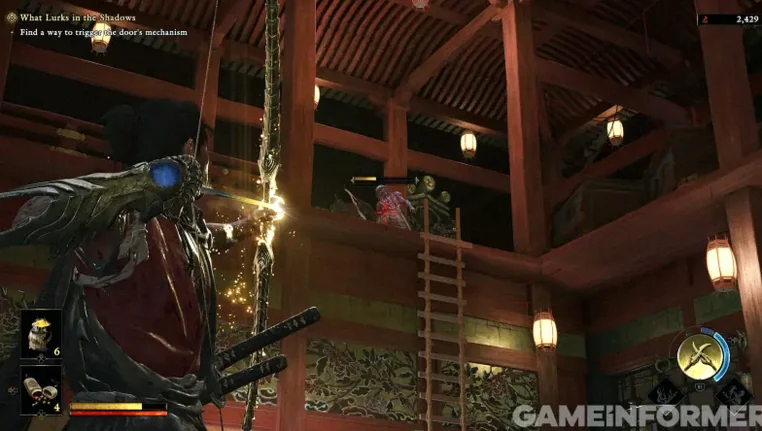
Action-first releases often need a breather between fights, and Capcom’s return to samurai-style action in Onimusha: Way of the Sword is making that break feel more “built into the world.” During a hands-on preview in Osaka, the Game Informer team found something notable in the game’s structure: the series’ familiar puzzle boxes aren’t there anymore—and they’ve been replaced by environmental puzzles that live inside stages.
Puzzle boxes removed, but puzzle moments remain
Across the original Onimusha lineup—Warlords, Samurai’s Destiny, Demon Siege, and Dawn of Dreams—puzzle boxes were a recognizable staple. In a roughly three-hour hands-on session with Way of the Sword, however, those boxes simply weren’t present. When director Satoru Nihei was asked whether the preview had missed anything, the answer was straightforward: Way of the Sword doesn’t include puzzle boxes at all.
Nihei also framed the change as an evolution rather than a removal. Instead of relying on that familiar puzzle-box format, the game introduces puzzle elements directly in each stage. The goal is to interrupt the flow of combat with moments that get you thinking before returning you to sword-focused action.
A new environmental puzzle in Dokyo’s underground lab
One of the clearest examples came about halfway through the demo in Dokyo’s underground lab. Set beneath the imperial castle in Kyoto, the scene follows Dokyo as she splices together Genma, humans, animals, and other materials to create new demonic threats.
The stage itself leans into a ghost-house-like atmosphere, but the standout moment for this hands-on was a puzzle that didn’t resemble anything from earlier Onimusha entries. In a large room styled like a kabuki theater space, four masks hang on the wall. The game makes it clear you need to interact with them to progress, yet there’s no obvious switch or lever—at least not from the first pass.
The solution comes from reading the environment. Light shines through decorative windows, and ornaments suspended in each window cast patterns that correspond to the masks. Each ornament reveals a different number of holes on the matching mask—one for the first, two for the second, and so on. By looking at the ornaments from left to right, the player can determine how to interact with the masks inside the room.
The hands-on player spent longer than expected working it out, with Shizuka—a mysterious figure tied to Miyamoto Musashi’s Oni Gauntlet, or connected to it in some way—offering helpful, polite nudges. The puzzle ultimately took only a few minutes before combat resumed.
Why the switch matters for pacing and stage design
Nihei’s broader point is that action is the main draw, but “just action” isn’t automatically engaging for everyone. By embedding puzzle elements into each stage, the design aims to create intentional pauses in between action sections—moments that encourage observation and problem-solving rather than constant fighting.
That philosophy shows up in the Dokyo lab example: the puzzle functions as a small break from combat while still being tightly connected to the stage’s presentation. It also reinforces the idea that Way of the Sword is trying to keep players in the world, using environmental clues rather than a recurring, standalone puzzle-box mechanic.
Key points
- Puzzle boxes are not in Onimusha: Way of the Sword, according to director Satoru Nihei.
- Instead, the game uses environmental puzzles placed inside stages to vary pacing.
- A hands-on example in Dokyo’s Kyoto lab involves reading light patterns through decorative windows to interact with wall masks.
- Director Satoru Nihei says puzzles are designed to get players thinking between action segments.
| Onimusha entry (series) | Puzzle boxes status in Way of the Sword context |
|---|---|
| Warlords / Samurai’s Destiny / Demon Siege / Dawn of Dreams | Puzzle boxes were staples in these games |
| Onimusha: Way of the Sword | No puzzle boxes; environmental puzzles replace them |
Expert View
This change signals a franchise that’s trying to modernize its pacing without abandoning the “Onimusha brain” moments. For players who loved puzzle boxes as a recognizable rhythm, the good news is that Way of the Sword appears to keep the need to pause and interpret clues—just in a more diegetic, stage-integrated way. In a competitive media cycle, that matters: it gives content creators and streamers more variety than one-off combat clips, and it may help the community form a new set of expectations around how exploration and observation work in the series’ comeback.