Ethan Crossfield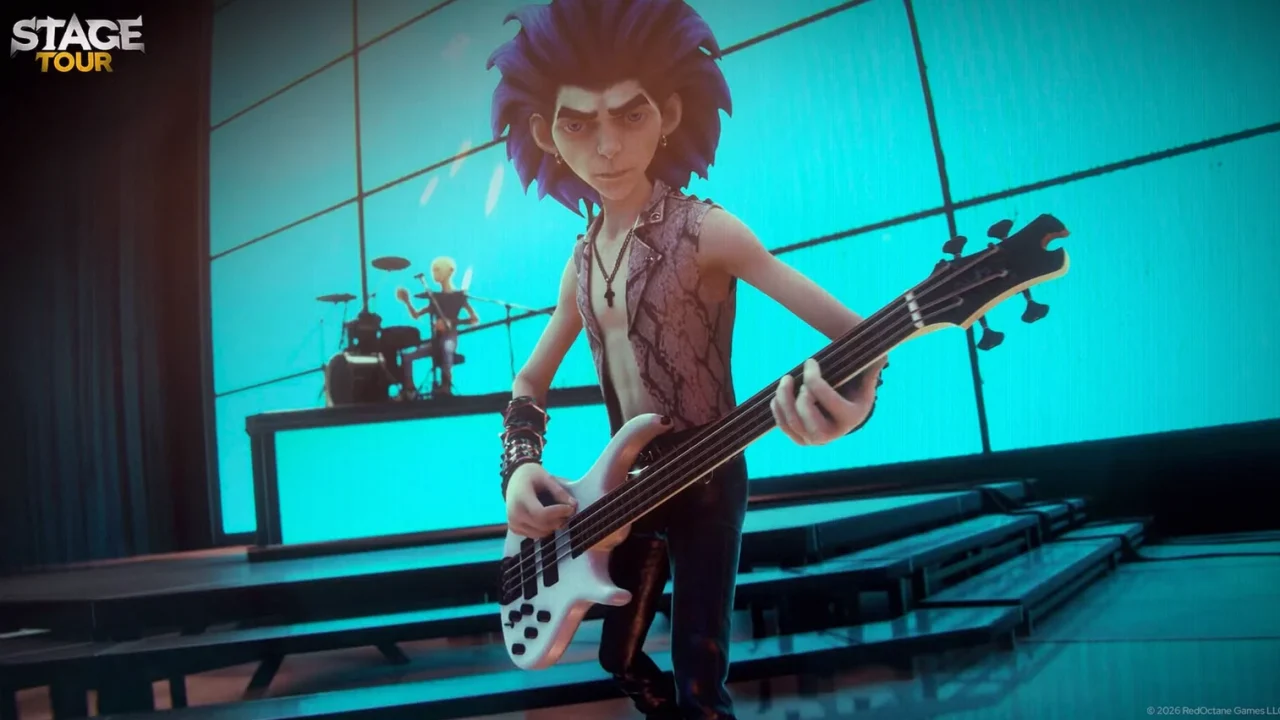
Music games are preparing for a notable comeback as former Guitar Hero developers return with a new stage-focused rhythm experience. RedOctane Games used Gamescom Opening Night Live to confirm that Stage Tour will launch on December 10, 2026, bringing a large licensed soundtrack, multiple play styles, and optional instrument bundles to PC and current-generation consoles.
A New Project From the Original Guitar Hero Era
RedOctane's name carries particular weight among rhythm-game fans. The company was founded in the 1990s and became closely associated with the early Guitar Hero games through collaborations with Harmonix and Neversoft. Activision shut the studio down in 2010, but former developers revived RedOctane in August 2025. Some members of the revived team also worked on the first Guitar Hero games.
Stage Tour, announced in February, is the studio's first new project since Guitar Hero World Tour. Its design clearly draws from the instrument-based format that helped define the genre, while its newly revealed features give the game an identity beyond a simple return to the past.
Release Date, Songs, and Gameplay Modes
Stage Tour arrives December 10, 2026, on PC, PlayStation 5, Xbox Series X/S, and Nintendo Switch 2. The Gamescom trailer confirmed a soundtrack of more than 90 songs spanning six decades. The announced artists include Motley Crue, Paramore, Radiohead, Olivia Rodrigo, Babymetal, and Fall Out Boy.
Five modes are confirmed for launch: Quickplay, Practice, Judgements, Karaoke, and Tour Mode. Tour Mode is the most substantial addition for fans of traditional rhythm-game campaigns. It uses a roguelite structure in which players select bandmates and progress through gigs with outcomes that can vary between runs. That format could give the campaign more replay value than a fixed song progression, although the source material does not yet detail how deep those variations will be.
Licensed Gear and Launch-Day Customization
The game will also include a sizable collection of equipment and character customization. More than 180 licensed guitars from manufacturers including Gibson and Epiphone can be unlocked and equipped. Players will also be able to build a roster from more than 50 bandmates, with clothing and accessory options available for them.
RedOctane has confirmed that the Standard Edition will cost $39.99 on all four platforms. Digital pre-orders for that edition were not live at the time of the announcement, but hardware bundles were available for pre-purchase through the official Stage Tour website.
What Players Can Buy
The Kramer Guitar & Game Bundle costs $129.99 and includes the game plus a compatible Kramer guitar controller. The Band Kit + Game Bundle is priced at $299.99 and contains the game, a guitar, a complete drum set, and a microphone. Players can also buy the peripherals separately: the guitar costs $109.99, the drum kit is $199.99, and wireless and wired microphones cost $29.99 and $19.99 respectively.
Key points
- Stage Tour launches December 10, 2026.
- The game is coming to PC, PS5, Xbox Series X/S, and Nintendo Switch 2.
- More than 90 songs and five launch modes have been confirmed.
- The Standard Edition costs $39.99, with instrument bundles available.
Confirmed Stage Tour editions and peripherals
| Product | Contents | Price |
|---|---|---|
| Standard Edition | Game | $39.99 |
| Kramer Guitar & Game Bundle | Game and Kramer guitar controller | $129.99 |
| Band Kit + Game Bundle | Game, guitar, drum set, and microphone | $299.99 |
| Guitar | Standalone peripheral | $109.99 |
| Drum kit | Standalone peripheral | $199.99 |
| Wireless microphone | Standalone peripheral | $29.99 |
| Wired microphone | Standalone peripheral | $19.99 |
Expert View
Stage Tour's announcement positions it as both a nostalgia-driven revival and a modern platform release. The broad soundtrack, licensed hardware, and roguelite Tour Mode give RedOctane several ways to reach established Guitar Hero fans while offering new players more than a straightforward song list. Its success will likely depend on how well those systems work together and whether the confirmed song lineup and peripherals justify the investment for rhythm-game audiences.