Ethan Crossfield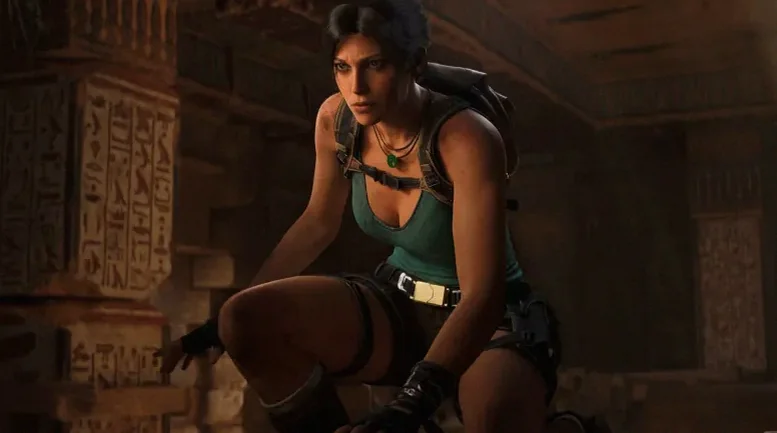
As generative AI becomes a bigger part of game development conversations, Crystal Dynamics’ Tomb Raider: Legacy of Atlantis is now the latest project to address where it fits in the pipeline. During Summer Game Fest 2026 media play days, experience director Jeff Adams explained how the studio views AI as a tool for faster iteration—while emphasizing that the finished work remains human-crafted.
What prompted the AI discussion at SGF
The topic gained traction after Tomb Raider: Legacy of Atlantis resurfaced publicly, including a PlayStation State of Play appearance that brought a new February 12 release date and a Steam disclosure mentioning generative AI. That disclosure indicates the developers—Crystal Dynamics and Flying Wild Hog—used AI at some point, while also stating that all AI assets have since been “replaced or refined by humans.”
At Summer Game Fest 2026, Game Informer had the chance to play the experience and interview Crystal Dynamics. In that conversation, senior video editor Alex Van Aken asked Jeff Adams directly about generative AI and how it’s being used during development.
Jeff Adams: AI to visualize ideas, then traditional production takes over
Adams framed generative AI as an internal tool meant to help the team reach decisions more quickly. His example focused on early level development: if the studio has an idea for an object but isn’t sure whether it’s worth the development time to build, generative AI can be used to visualize how that object might look in the world.
If the visualization holds up, Adams said the project moves the concept into the studio’s traditional pipeline. From there, the team conceptually develops the asset, builds it using standard processes, and ensures the final content ships as human-made. He also stressed that the studio’s priority is producing the highest-quality game experience for players.
How the studio responded to deeper technical questions
When the interview moved toward implementation details—such as whether generative assets come with scripts attached or whether they function strictly as an environmental art tool—a PR representative stepped in. The representative indicated the studio had already covered what it wanted to say for the moment and suggested they would be more comfortable discussing further after launch, when the game is visible to everyone.
Adams later reiterated the overall intent: making it as easy as possible for the team to deliver high-quality game experiences.
Release timing and what players can expect next
Tomb Raider: Legacy of Atlantis is scheduled to launch next year on February 12 for PlayStation 5, Xbox Series X/S, Nintendo Switch 2, and PC. For readers interested in the broader context, Game Informer also pointed to its preview coverage and the latest game trailer alongside the discussion.
With the game’s release approaching, the most immediate “next step” for the community is simple: see how the studio’s stated approach plays out in the final experience—especially in areas players will notice, such as environmental detail and asset quality.
Key points
- Steam’s disclosure says generative AI was used at some point, but AI assets have been replaced or refined by humans.
- Jeff Adams described AI as a visualization aid during early level development to test object ideas faster.
- Once an idea is approved, it moves into the traditional pipeline for concepting, building, and human-crafted final content.
- When asked for deeper technical specifics, a PR representative said the studio would likely wait until after launch.
Confirmed launch details
| Platform | Release date |
|---|---|
| PlayStation 5 | February 12 (next year) |
| Xbox Series X/S | February 12 (next year) |
| Nintendo Switch 2 | February 12 (next year) |
| PC | February 12 (next year) |
Expert View
This interview signals a cautious, process-focused way the major studios are trying to normalize generative AI: use it early to accelerate iteration, but keep the bar for shipped assets firmly human-led. For players, the takeaway isn’t just whether AI was involved—it’s how the studio claims quality control works once concepts become final game content. For the wider industry, Crystal Dynamics’ approach reflects a likely trend: studios will increasingly frame AI as an internal productivity layer while reserving detailed technical disclosure for after release.