Ethan Crossfield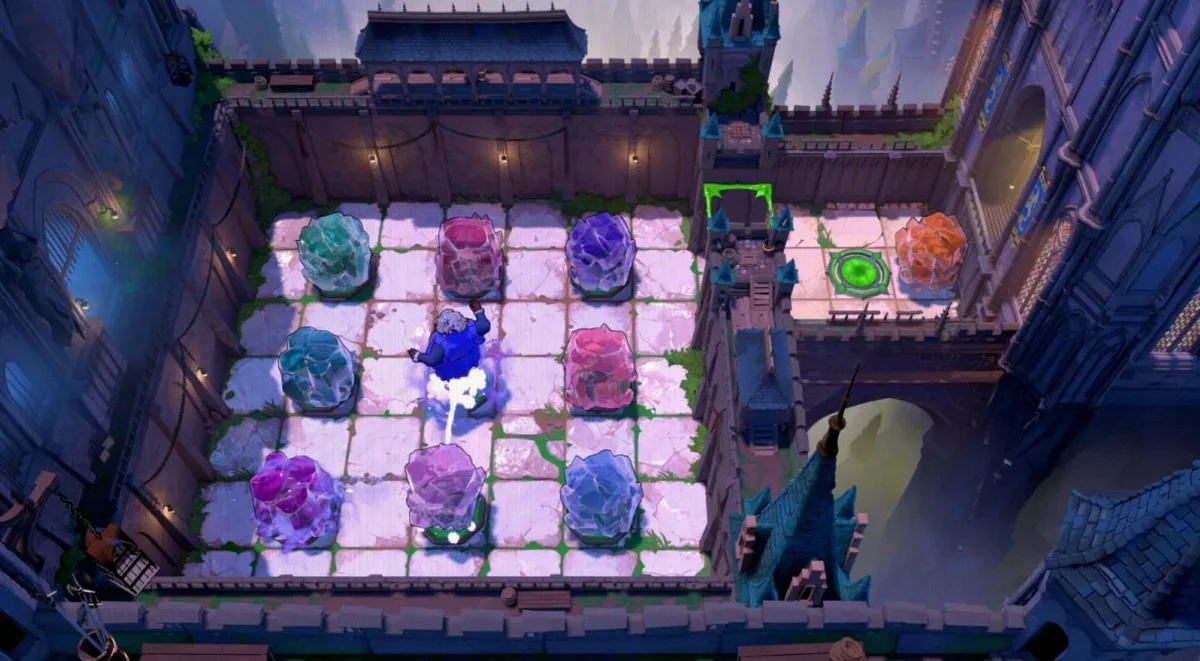
Order Of The Sinking Star, the next puzzle adventure from Braid and The Witness creator Jonathan Blow and his studio Thekla, will launch on October 8. The project is positioning itself as an unusually broad puzzle experience, combining more than 1,000 interconnected challenges with a fantasy adventure built across four distinct biomes.
What happened
Thekla confirmed the release date for Order Of The Sinking Star after the game was first revealed at The Game Awards 2025. It will be available on PlayStation 5, Switch 2, and PC.
The game follows a princess who is transported to another world. That setting is divided into four biomes, each featuring its own characters and puzzles. As players progress, the separate areas and their ideas are designed to come together, creating increasingly complicated combinations of mechanics.
The scale of the project extends beyond Thekla’s core team. The studio brought in additional puzzle designers, including Alan Hazelden, Sean Barrett, Jonah Ostroff, Zach Polansky, Patrick Traynor, and Marc ten Bosch. Their listed work includes games such as Skipping Stones to Lonely Homes, Mirror Isles, Promesst, Heroes of Sokoban, Enigmash, Patrick’s Parabox, and Miegakure.
Why it matters
Order Of The Sinking Star is notable not simply because it comes from the creator of two influential puzzle games. Its central ambition is to make a large-scale adventure out of a genre that often focuses on compact, self-contained challenges. More than 1,000 puzzles, connected across several environments, suggest a game built around long-term discovery rather than a short sequence of isolated brainteasers.
That structure could also give the project a distinctive identity. The four biomes are not presented as separate chapters with unrelated gimmicks; their mechanics are intended to eventually intersect. For players who enjoy recognizing patterns and applying an idea in a new context, that progression may be the game’s most compelling feature.
Jonathan Blow has credited the outside designers with making the project possible, describing the collaboration as a way to combine ambitious puzzle concepts from multiple creators. The breadth of that design partnership makes Order Of The Sinking Star an interesting test of how many puzzle philosophies can coexist within one adventure.
What to watch next
The October 8 launch date gives players a clear point to assess whether the game’s considerable scale translates into a coherent experience. The key question is how naturally the individual puzzles, characters, and biome-specific mechanics connect as the adventure advances.
Platform availability is also worth noting. Order Of The Sinking Star is coming to PS5, Switch 2, and PC, giving puzzle fans several ways to approach a game built around exploration and careful problem-solving. The source material does not provide pricing, additional editions, or further launch details, so those parts of the release remain unconfirmed.
For now, the defining promise is clear: Thekla is attempting a puzzle adventure whose systems grow more intertwined over time, supported by a notably large group of designers.
Key takeaways
- Order Of The Sinking Star launches October 8.
- The game includes more than 1,000 interconnected puzzles.
- Its adventure takes place across four biomes in a fantasy world.
- Jonathan Blow and Thekla collaborated with several outside puzzle designers.
- The game is planned for PS5, Switch 2, and PC.
Expert View
The most intriguing part of Order Of The Sinking Star is its attempt to make puzzle design feel cumulative. A large puzzle count alone would mean little, but linking four biome-specific systems into more complex combinations could give the adventure a strong sense of progression. The collaboration also raises expectations: bringing together designers with different specialties may expand the game’s creative range, provided those ideas remain readable and purposeful. October 8 will show whether this unusually ambitious structure feels like a unified world rather than a collection of experiments.